How Play Media Automated Media Workflows and Cut OTT Publishing Time
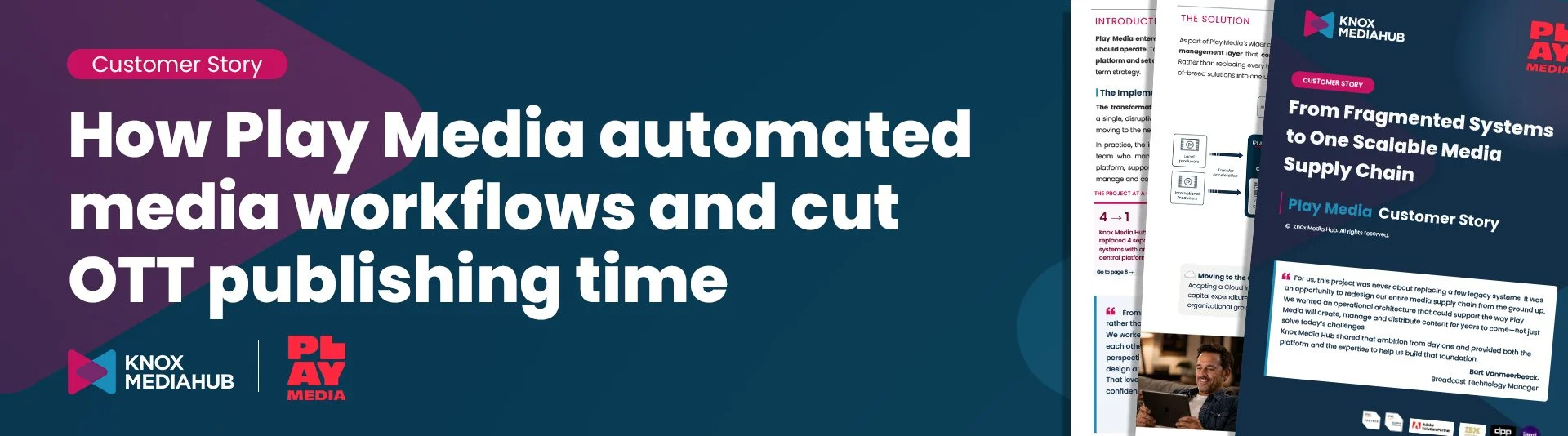
Play Media has replaced four disconnected systems with one cloud media backbone built around Knox Media Hub. The result: automated cataloguing from more than 100 providers, self-service access for approximately 200 users, and an OTT publishing workflow reduced from about 45 minutes to 10–15.
Why Play Media needed a different operating model
Modern broadcasting is no longer one channel, one audience or one delivery path. A broadcaster may be scheduling linear television, publishing to an OTT service and preparing content for digital outlets at the same time. Each destination has its own formats, deadlines and operational requirements.
That is the reality behind Play Media’s transformation. The Flemish broadcaster operates five TV channels, an extensive OTT platform and digital outlets, while managing internationally acquired programmes, locally produced content and live material. As that operation expanded, content and work became distributed across separate systems. Fragmentation made assets harder to locate, created more hand-offs between teams and limited the broadcaster's ability to add new workflows without adding more operational complexity.
The challenge was not simply to replace ageing software. It was to create an operational foundation that could support all those workflows as the business evolved. Play Media needed an operating model that could coordinate content, metadata, people and specialist technology from one place.
From four systems to one media backbone
Before the project, content and work were spread across four separate systems. That fragmentation made it harder to see where an asset was, coordinate teams and scale new workflows without adding more tools or manual steps.
Play Media consolidated those systems into one cloud-based media backbone with Knox Media Hub at its centre. Content, metadata, workflows and access now come together in a shared environment. Teams can work from the same source while retaining the specialist systems they need.
The point is not centralisation for its own sake. It is to reduce the hand-offs, duplicate work and blind spots that slow content down.
“We wanted an operational architecture that could support the way Play Media will create, manage and distribute content for years to come.”
Bart Vanmeerbeeck, Broadcast Technology Manager at Play Media
Automation from provider delivery to publication
More than 100 providers deliver content to Play Media. Those files need to be received, identified, catalogued, processed and made available to the right destinations and teams.
Definition: Media workflow orchestration uses metadata, rules and connected services to move audiovisual content through repeatable steps such as ingest, cataloguing, processing, approval and publication. It reduces manual hand-offs while keeping teams in control of exceptions and editorial decisions.
Automated workflows now handle much of that path. Incoming files are catalogued using available metadata, then routed through the required processing steps. Instead of moving every asset manually between tools, teams can manage exceptions and focus on work that needs human judgment.
The most visible result is in OTT publishing. A process that previously took around 45 minutes now takes 10–15 minutes: roughly three times faster.
Why an open architecture mattered
A modern media supply chain is never a single closed system. It needs to connect storage, processing, quality control, scheduling, AI tagging and other specialist services.
The Play Media architecture was designed around that reality. Knox Media Hub provides the management and orchestration layer and connects those services through an API-based architecture. This is also why the platform sits beyond a conventional MAM: it combines asset management with workflow orchestration and distribution.
For a concise explanation of the categories, see MAM, DAM and PAM: what is what?
For Play Media, the practical benefit is adaptability. A new partner, processing service or distribution workflow can be introduced without rebuilding the entire operation or creating another isolated content silo.
Self-service access without losing control
Approximately 200 users now work through the platform. They include teams with different priorities and levels of technical expertise, so access had to be simple without becoming uncontrolled.
Self-service portals give authorised users direct access to the content and functions relevant to them. That reduces internal requests and waiting time while keeping permissions, metadata and workflows centrally managed.
For OTT, marketing, press, social and subtitling teams, faster access means they no longer need to operate like separate companies waiting for the same material.
In short, controlled self-service gives teams faster access to media while preserving permissions, metadata standards and workflow governance. It removes avoidable requests without removing operational oversight.
More than a software installation
The customer story also looks at the part transformation summaries often skip: implementation.
The project combined workflow mapping, design sessions, phased deployment and administrator training. The objective was not merely to install a platform and leave. It was to give Play Media’s team the knowledge and autonomy to operate and extend it independently.
The Play Media team was trained to operate and extend the environment independently rather than depend on a supplier for every change. This reflects Knox Media Hub's broader approach to consultative implementation and change management: define the workflow, establish measurable goals and train key users.
It also explains why Vanmeerbeeck described the work as a foundation for the future rather than a simple software replacement.
📊 The outcome in numbers
4 systems consolidated into 1 scalable media supply chain
OTT publishing reduced from around 45 minutes to 10–15 minutes
Automated content cataloguing from more than 100 providers
Self-service access for approximately 200 users
More operational capacity without increasing headcount
What broadcasters can learn from the project
1️⃣ Start with the bottleneck, not the product. Map where content waits, where metadata breaks and where teams depend on manual requests before choosing what to automate.
2️⃣ Use one operational layer without forcing one tool to do everything. Orchestration should connect specialist services, not recreate them badly.
3️⃣ Treat metadata as the enabler for automation. Automation depends on information that can identify an asset and determine what should happen next. It should be clean, structured and compliant.
4️⃣ Design self-service with governance. The aim is faster access for authorised teams, not uncontrolled duplication or sharing.
5️⃣ Measure a workflow before and after. Play Media's publishing-time comparison turns an abstract transformation into an operational benchmark.
📖 Top 3 reasons to download the case study
See the architecture, not only the headline results
The full story shows how a central media backbone can connect content, metadata, workflows and specialist systems in a working broadcast environment.
Understand how the transformation was implemented
Explore the design sessions, phased rollout and training that helped turn the technology into an operation the Play Media team could manage independently.
Take away practical benchmarks
Use Play Media’s workflow improvements, user scale and provider volumes as useful reference points for your own media supply chain planning.