What the FIFA World Cup 2026 Teaches Us About Modern Media Operations
One of the best things about a World Cup isn't just the matches. For one month, the entire media industry shows its work in public. Broadcasters, streamers, rights holders, and creators explain how they're producing, distributing, localizing, and monetizing one of the biggest live events on the planet. The trade press fills up with behind-the-scenes stories, and underneath the trophy talk, there's a rich conversation about how modern content actually gets made, moved, and repurposed.
TL;DR
The FIFA World Cup 2026 is compressing and proving a decade of media and technology trends into a standard: remote production, decentralized teams, cloud workflows, platform-specific content, second-screen audiences, AI-assisted metadata, faster localization, and more rights windows and formats than ever before.
Much of this confirms what Knox Media Hub has focused on for years: high-volume content operations, global distribution, metadata-driven workflows, and the need to simplify growingly complex media supply chains without adding more tools to the stack.
The scale of the FIFA World Cup 2026 edition
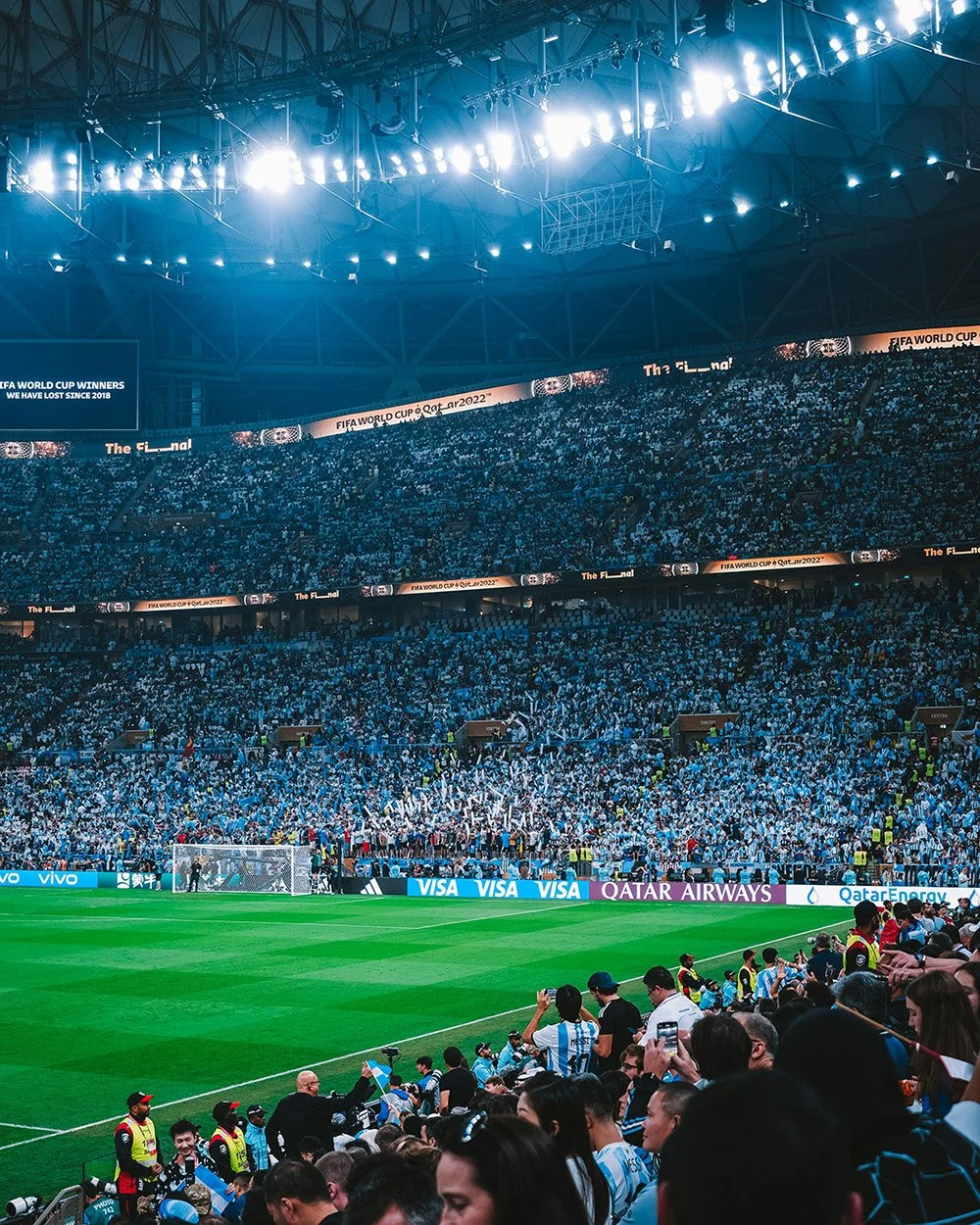
The 2026 World Cup is taking place between 11 June and 19 July. It has 60% more matches than the previous Qatar edition in 2022
For the first time, the FIFA World Cup features 48 teams, expanding from 64 to 104 matches, 62.5% more than past editions. But the real jump in content is far bigger than the match count suggests: every match generates its own ecosystem of live feeds, highlights, vertical clips, near-live moments, and app experiences.
This is also the first World Cup hosted across three nations, spanning 16 stadiums over 27 consecutive days without a break.
This scale is unprecedented. So how are rights holders, broadcasters, and streamers managing it?
A few years ago, three host nations might have meant tripling teams, facilities, and systems: scaling by addition. But more crews, more studios, more equipment, and more tools also mean more manual steps, more chaos, and much higher costs. That approach isn't sustainable at this scale.
That's why this edition is pushing the industry toward something Knox Media Hub has championed for years: remote production and orchestration. Managing this scale isn't about adding resources, it's about better-orchestrated media operations and a supply chain designed to move faster, with fewer operational gaps.
⚽
Remote, decentralized, but not new
Hosting across three countries has made remote, decentralized production the only viable path. It’s also the most cost-effective option, the most flexible one, and really the only one that makes a cross-country tournament like this possible.
The World Cup is spread across three countries. Remote is necessary. And remote means cloud.
Here's how it works in practice: editing teams and central operations sit in home-country hubs, receiving content from host cities. Those hubs then get it in front of the right people, in the right place, as fast as possible.
As SVG suggests, decentralized production at scale may be this tournament's lasting legacy.
Meanwhile, content is just as decentralized as the production behind it. This is also the first World Cup where streaming audiences are expected to exceed linear audiences in several markets, with matches available on YouTube, direct-to-consumer apps, and social platforms, each with its own playout requirements, formats, and rights windows that don't forgive mistakes.
In these environments, teams can't wait for files to move through a slow, manual chain. They need immediate access, clear metadata, secure collaboration, automated distribution, and a single operational layer connecting teams, partners, and rights holders. When production becomes decentralized, the media supply chain has to become more unified.
For Knox Media Hub, this isn't a new direction. It's the type of problem we've worked on for years with high-pressure sports operations like MotoGP : remote, decentralized, platform-agnostic, metadata-rich workflows where content needs to be available almost immediately.
⚽
The other half of the match story
For years, shoulder content, clip culture, cross-screen viewing, and remote production were interesting industry observations. At the 2026 World Cup, they're the strategy.
Here's the shift that defines this tournament more than any other: the match itself is no longer where most of the watching happens. Audiences have moved into what the industry calls shoulder content: the online conversations, reactions, clips, and post-game analysis surrounding the live event. Digital-first shoulder content can outpace official broadcast views by as much as 20x.
Consider what one 90-minute match now has to become:
A live feed for linear broadcast across multiple territories
A streaming feed for direct-to-consumer platforms
Near-live highlight packages at multiple lengths, from three-minute summaries to 30-second goal clips
Vertical clips for TikTok, Reels, and Shorts, each with its own specs and rules
Individual moment clips for goals, saves, celebrations, and controversies
Multi-language versions of all of the above: commentary, subtitles, captions, on-screen graphics
Territory-specific packages respecting local rights windows, sponsor obligations, and editorial standards
Archive-ready masters, tagged correctly so they can be found again the moment they're needed
🥵
As TVB Europe put it in its coverage of the tournament, the broadcast feed is “no longer just a feed; it is the raw material for highlights, social clips, alternate angles and digital storytelling.”
This creates two challenges:
Getting content to travel across a growing number of platforms
The bottleneck in modern live sport isn't capturing footage. It's the downstream supply chain that turns one match into hundreds of deliverables, fast, in the right formats and languages. For content owners, this points to one capability: the ability to deliver quality content everywhere, with the flexibility to reach an audience wherever it has gathered.
Doing it fast
There's another competition happening in parallel: who wins social, who gets the clip views, who sets the trend. Sports content is one of the fastest-moving categories in media. Last week's match is already old news; the value sits in the hours right after the event, while the audience is still paying attention. Speed isn't a nice-to-have in sports media operations, it's part of the product.
Cloud workflows, remote production, AI-assisted clipping, and automated metadata are some of the levers the industry is using to keep up. But they only solve the problem if they're connected to a coherent operation. That's the case Knox Media Hub has been making for years: the answer to more content isn't more tools, it's better orchestration. It's giving teams one place to plan, produce, and distribute content, instead of stitching together a growing list of point solutions.
A 62.5% jump in matches. An exponential jump in content. The answer isn't more tools, it's better ones.
⚽

Simultaneously Global and Local
A World Cup is, by definition, the most linguistically diverse audience a media operation will ever serve. A goal scored in Mexico City has to reach a viewer on the other side of the globe, expecting commentary, subtitles, and on-screen information in their own language, along with highlights of their own team, cut a particular way.
The whole world is the audience, but every country wants its own team, its own commentators, its own framing. One world feed fans out into many rights holders, many languages, and many editorial takes.
The only way to scale that without it collapsing is with immediacy and a system built to repurpose: giving every team across the operation access to the same assets so they can adapt and re-cut content on the spot, the way clip culture demands.
This isn't hypothetical for us. It's what we deliver: one single source for many languages, many rights holders, many platforms. The World Cup is the same problem with the volume turned up and the deadline pulled in.
AI has found its place here too, speeding up the more repetitive parts of localization. Localization has long stoped being the slow, expensive link in the chain and becomes a fast, repeatable step in the pipeline.
⚽
If you can’t find it, you can’t sell it
Two threads of this tournament come down to the same thing: data and metadata.
The first is commercial. Brand sponsorship value depends on visibility, which raises an uncomfortable question for any content owner: can you instantly find every frame where a sponsor appears, on a pitch-side board, on a shirt, in a passing mention? Is your content tagged well enough to prove it?
The second is editorial and fan-facing. FIFA has formalized what it calls its football data ecosystem, moving into what is termed “datatainment”: using live data and visualization to help fans understand the game.
That raises a fair question: do you understand your own data and media as well as you understand the match? The operations getting the most value from this tournament are the ones whose content can describe itself, moving through the supply chain with less manual effort.
That doesn't mean metadata for its own sake. It means operational metadata: rights, languages, sponsors, people, territories, formats, delivery status, approvals, and usage. The kind of information that actually helps content move.
⚽
Key takeaways: what this tells us about the present of media operations
This tournament feels like the culmination of trends we've been tracking for years, and in some ways a continuation of what we saw at the Paris 2024 Olympic Games:
We treated second-screen behaviour as something happening around the broadcast. → Now it is designed into the experience.
We debated whether digital platforms were a true distribution window or only a marketing channel. → Now they are central to reach and engagement.
We spent years asking what role YouTube and social platforms would play in sports. → Now they are part of the distribution strategy.
We watched global plus local become the formula for streaming. → At the World Cup, it becomes the operational reality.
We talked about AI in media operations as a future layer. → Now it is becoming useful when connected to structured content and metadata.
In the Qatar FIFA World Cup in 2022, many of these behaviors were still described as observations: multiscreen consumption, social conversation, phone-first discovery, fast highlights, vertical clips, data overlays. They mattered, but they were often treated as something added on top of the main product.
Four years later, matches are being produced for this reality from the start. That's what a digital-first media supply chain actually means.
It's also where Knox Media Hub focuses: helping teams manage and distribute large volumes of content globally, quickly and securely, across every screen, without letting the supply chain collapse under its own complexity.
📚 Sources
The Guardian: Podcast wars, BBC, ITV, The Rest Is Football, Netflix and the FIFA World Cup
SVG Europe: Mid-half water breaks create new opportunities to engage Gen Z
SVG Europe: EBU adapts to stay relevant to members
Rethink Research: A World Cup of firsts, streaming maturity, Dolby AC-4, AI avatars, 104 matches
SVG: How decentralized production may well be the legacy of the 2026 FIFA World Cup
TVB Europe: The battle for attention, technology and connectivity at FIFA World Cup 2026
Want more Media Technology insights? Subscribe to our newsletter 📥