Cloud-First in 2026: Why Hybrid Media Workflows Are the Next Step
In 2026, the question is no longer whether media companies should use the cloud.
The conversation has now shifted into how to combine cloud flexibility with on-prem performance, existing infrastructure, and the operational reality of modern media businesses.
That is why hybrid media workflows are gaining ground. For broadcasters, distributors, sports rightsholders, and content owners, the future is not cloud-only and it is not a return to isolated legacy systems either. It is a more practical model where cloud and on-prem environments work together, with orchestration, automation, and visibility tying the whole thing together.
📋 Quick Summary
Cloud is a wide-spread technology. It is not a matter of “if” but “how”.
Hybrid is becoming popular because media teams need flexibility without losing control.
The goal is not to split workflows randomly between cloud and on-prem.
The goal is to place each task where it makes the most operational and financial sense.
The real bottleneck is rarely storage alone. It is fragmented workflows, duplicated tools, and poor orchestration.
In 2026, the strongest media operations are not choosing between cloud and on-prem. They are designing systems that use both intelligently.
The cloud conversation has changed
Some years ago, the industry conversation was dominated by a simple question: should media companies move to the cloud?
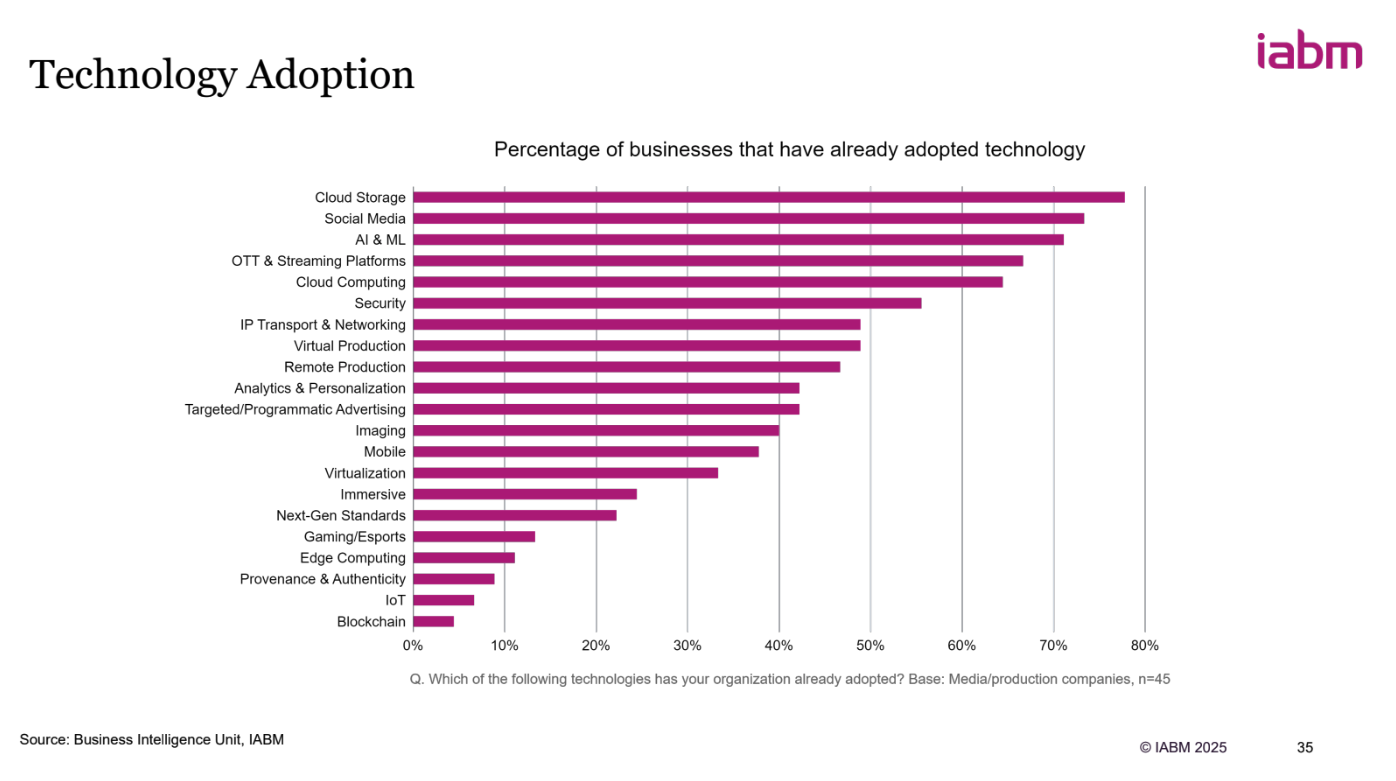
The IABM Business Intelligence Unit reported in 2025 that nearly 80% of media production companies are using cloud storage and over 60% integrating cloud computing.
In 2026, the question has changed. The issue is no longer whether cloud matters. It does. The issue is how to combine cloud flexibility with on-prem performance, existing infrastructure, and the operational reality of your business.
That shift is visible across industry reporting. NCS noted already last year that the cloud conversation had moved from hype to hard economics, with buyers focusing on storage costs, traffic expenses, performance needs, and total cost of ownership. The same article pointed to hybrid approaches as an increasingly attractive model because they balance on-prem reliability with cloud flexibility.
The DPP has also explored the state of Cloud Adoption across a series of reports, consistently concluding that adoption is now widespread and has matured into a new set of operational challenges.
Cloud has transformed media operations for the better. It enables faster onboarding, easier collaboration, elastic scale, and more agile service models. But that does not mean every task belongs there.
What a hybrid media workflow actually means
In practical terms, a hybrid media workflow is an operating model that combines on-premises infrastructure with cloud-based services so assets (video, data, metadata, and related assets), processing, and operational control can move across both environments as one coordinated workflow.
That definition matters because “hybrid” is often used loosely. It should not mean a patchwork of disconnected tools. It should mean a a healthy architecture where each part of the workflow runs in the environment that makes the most sense.
In practice, that often means:
Keeping high-resolution masters or latency-sensitive processes on-prem.
Using the cloud for collaboration, metadata handling, automation, orchestration, packaging, or distribution.
Connecting both environments through one orchestration layer instead of forcing teams to jump between tools.
Hybrid models should not be seen as a compromise. In many cases, they are the most realistic and effective architecture for media operations today.
What should stay on-prem and what should move to the cloud
There is no universal answer, but there is a useful pattern.
🗄️ Tasks that often make sense on-prem include:
Access to local master files
Performance-sensitive processing
Operations that depend on existing facility infrastructure
Specific security or governance-sensitive workloads
☁️ Tasks that often benefit from the cloud include:
Global collaboration
Workflow orchestration and automated distribution
Remote access
Metadata enrichment and transformation
Elastic storage
Partner-facing workflows such as review, screening, and delivery
We are starting to see companies reassessing where public cloud makes sense, where private infrastructure remains more predictable, and where hybrid models offer the best fit.
That is especially relevant in media, where workloads are uneven by nature. Live events, sports peaks, urgent deliveries, archive access, and multi-platform publishing do not all behave the same way. The best deployment model is rarely uniform.
Also note that the winning model is usually not about where the files sit. It is about how cleanly the workflow is orchestrated around them. That is why the strongest platforms in this space increasingly focus on workflow logic, metadata, interoperability, and automation rather than just storage claims.
The real risk is workflow fragmentation
This is where many media organizations still lose time and money.
The real problem is not simply having some things on-prem and others in the cloud. The real problem is managing your media through disconnected tools, duplicated steps, spreadsheet workarounds, and handoffs that depend on tribal knowledge.
This is also where the operational efficiency conversation becomes more important than the infrastructure itself. Media companies are trying to reduce complexity, consolidate vendors, unify workflows, and cut the number of touchpoints required to get content prepared, checked, and delivered.
That is the real danger in a weak hybrid strategy: not hybridity itself, but fragmentation. If your teams still have to rebuild metadata, chase files, launch manual transfers, or switch constantly between systems, the architecture may look modern on paper while remaining inefficient in practice.
Hybrid media workflows need orchestration, not just connectivity. Without that layer, organizations often end up with the worst of both worlds: local bottlenecks and cloud sprawl.
What media companies should look for in 2026
1. Can the workflow be orchestrated end to end?
A hybrid setup only works if content, metadata, and actions move together. If you need three tools and two manual checks just to trigger one delivery, the stack is already telling on itself.
2. Can teams work from one operational view?
Your operators, content teams, and external partners should not have to think like infrastructure engineers. The system should make the workflow coherent, even if the underlying environment is distributed.
3. Is metadata treated as a core operational layer?
Hybrid environments get complicated fast without strong metadata. If files move across locations, systems, and teams, metadata is what keeps them searchable, governable, and deliverable.
4. Can the model support both scale and control?
You want cloud elasticity where it helps, but without sacrificing control over the parts of the workflow that need to stay local or tightly managed.
5. Does the architecture reduce tool sprawl?
If the answer to every new workflow problem is to add another app, you are not building a stronger supply chain. You are building a more expensive one.
In 2026, Media owners are not just asking whether a platform is cloud-based. They are asking whether it helps them simplify operations, understand costs, improve delivery times, and adapt without ripping out everything they already depend on (spoiler alert: Knox Media Hub does!)
Conclusions
In 2026, hybrid media workflows are receiving more attention because they reflect how media companies actually operate.
Cloud has won the argument on flexibility, collaboration, and scalability. But local infrastructure, performance requirements, legacy estates, and cost discipline still matter. The strongest operating model is not ideological. It is selective, data-informed, and workflow-led.
The smartest teams are not choosing sides in an old debate. They are designing workflows that connect both worlds with as little friction as possible.
That is the real shift. Not cloud for the sake of it. Not on-prem for the sake of control. Just better media operations, built around the way work really gets done.
FAQ
▶️ What are hybrid media workflows?
Hybrid media workflows combine on-prem infrastructure and cloud-based services in one connected operational model. They allow media companies to place each task where it makes the most sense.
▶️ Why are hybrid workflows growing in media?
Because media companies need flexibility, remote collaboration, and scalable operations, but they also need to preserve performance, governance, and value from existing infrastructure.
▶️ Is hybrid better than cloud-only?
Not necessarily. But for many media organizations, hybrid is more practical because it balances local control with cloud agility.
▶️ What is the biggest challenge in hybrid media workflows?
Usually not the hybrid model itself. The real issue is fragmentation: too many disconnected tools, manual steps, and poor workflow orchestration.